

Four parts. No streaks, no daily pressure.
A journal that actually feels private.
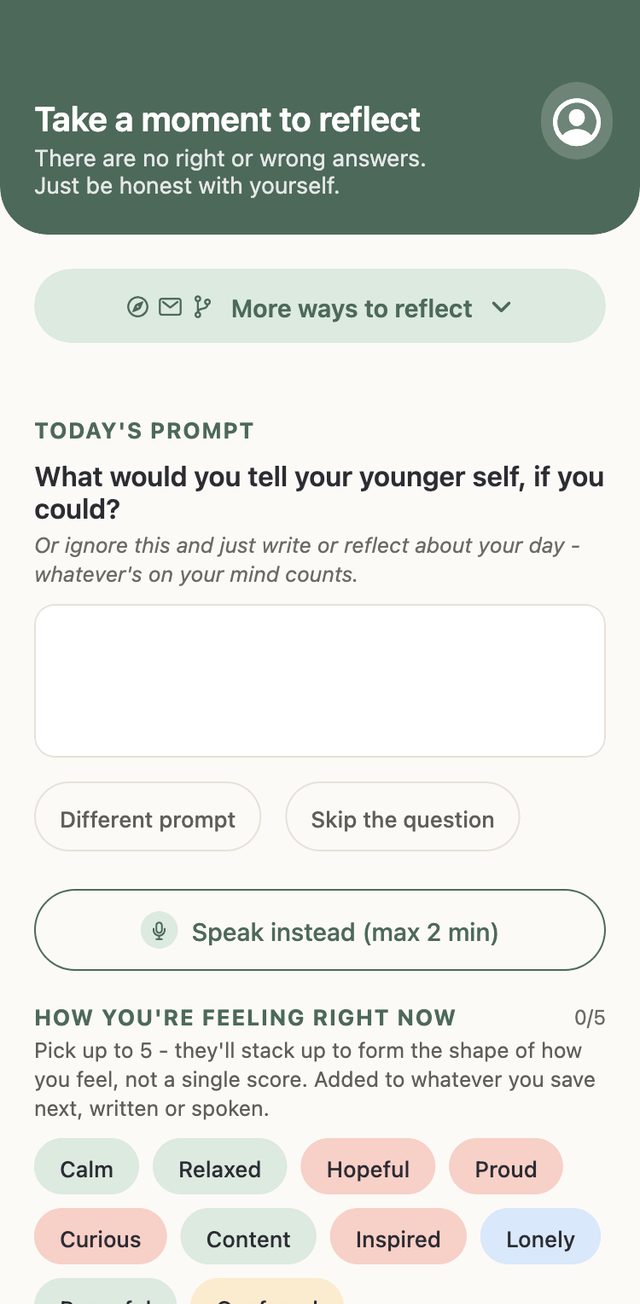
Write or speak whatever's on your mind. Private to you: no one at Wuna reads it. If you use the AI features, your text goes to our AI provider to write your summaries and patterns. Voice notes are turned into text and Wuna doesn't keep the recording; only your words remain.
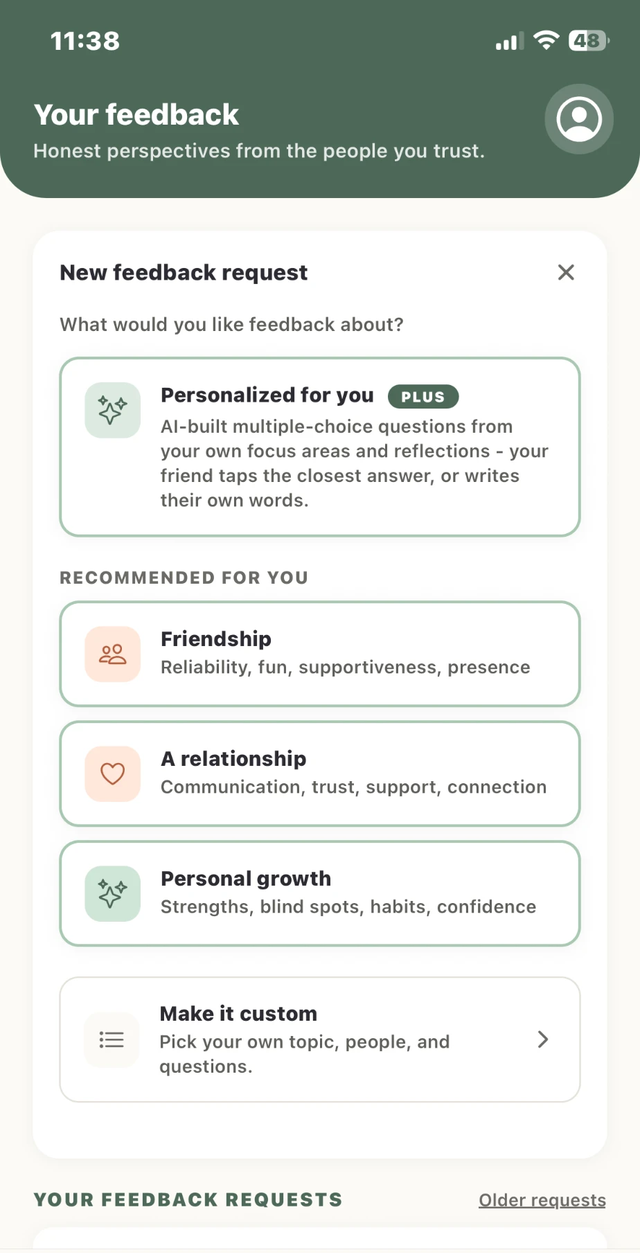
Ask a few honest questions, see what's real.
A few people you trust answer some honest questions about you, and their answers are mixed into one report, never linked back to a name. If you've answered the same questions yourself, Wuna can also show, only if you ask, where your view and theirs line up.
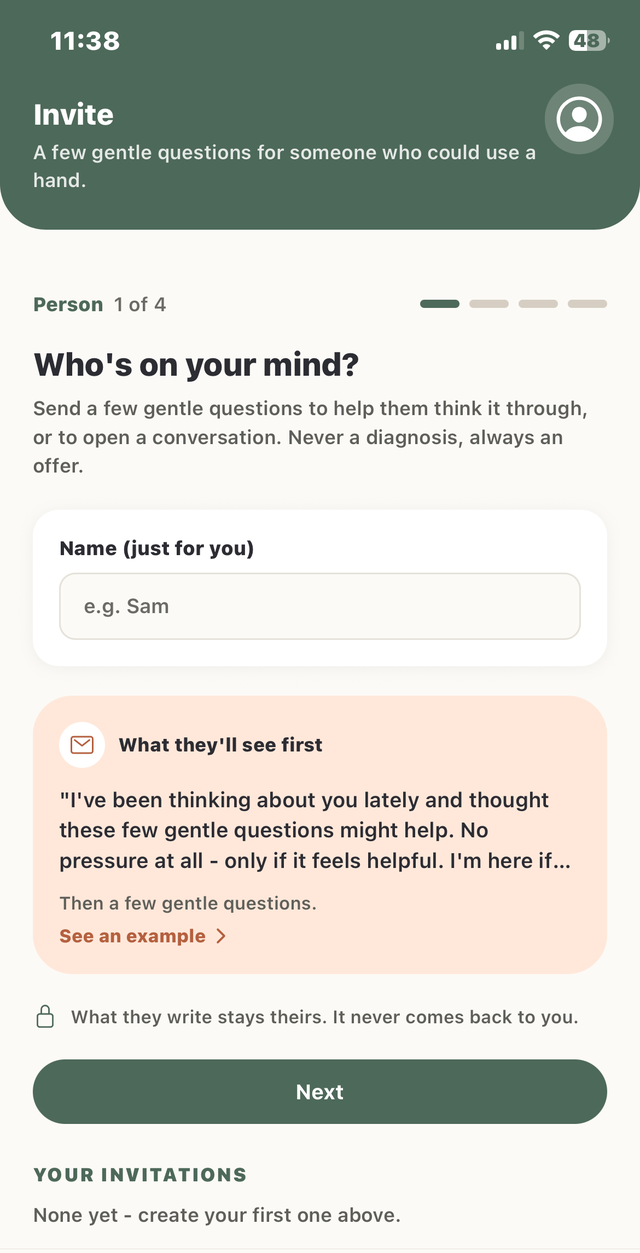
A gift, not a request.
Noticed someone who seems to be carrying something? Send them a few gentle questions, to help them think it through or to open a conversation when they're ready. They get a short reflection back right away, and nothing they write ever comes back to you.
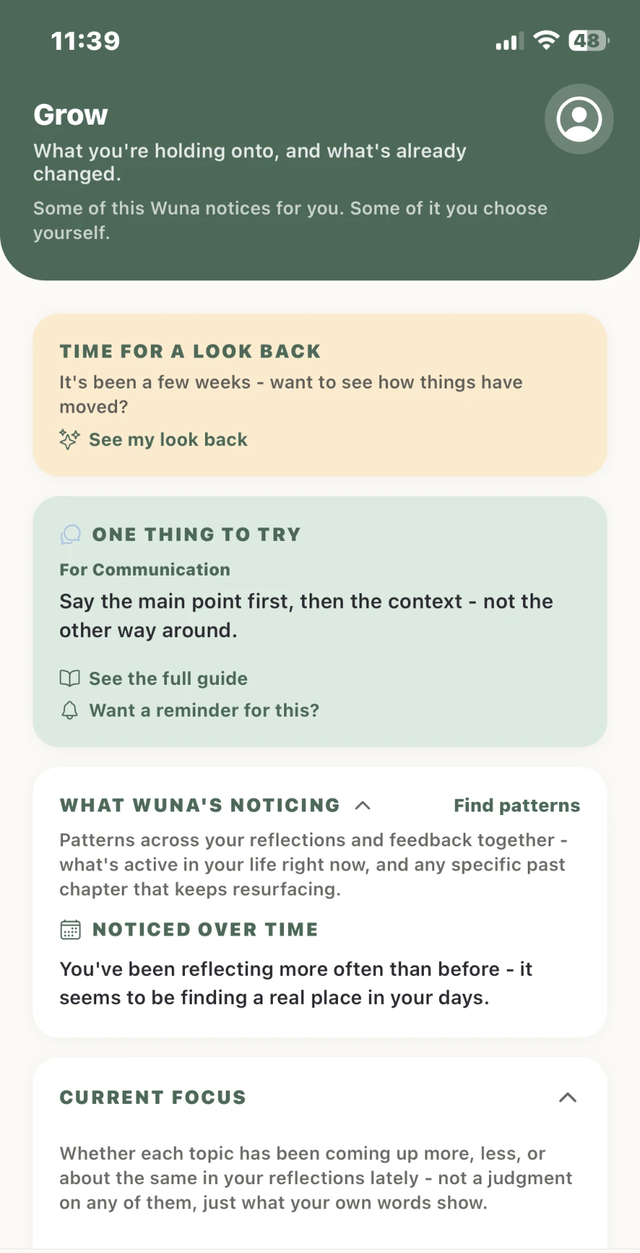
Hold onto what matters. Let go of what's done.
See what genuinely recurs across your reflections and their feedback: one or two things held at a time, released once they've truly changed. Never a score, never a streak.
Not a social app. Not a therapist. A mirror.
Honesty can't be designed. It can be made easier. Here's how Wuna tries.
Feedback is genuinely anonymous
Answers are mixed together before anyone sees them - no way to trace one back to a person, even for us.
Answers and voice recordings aren't kept longer than they have to be
Voice recordings are turned into text and Wuna doesn't keep the audio. Raw answers are permanently destroyed 30 days after the report is made, or after 90 days if no report is made.
No tracking, no targeted ads
Wuna doesn't use Google Analytics, Meta Pixel, or anything like them. Nothing you share here is ever used to target you.
You can delete everything, permanently
One tap in Settings removes your account and everything linked to it. There's no "soft delete."
See everything we promise
Your journal is private to you
No one at Wuna reads what you write or say, and nothing is made public. If you use the AI features, your text goes to our AI provider to write your summaries.
AI that notices, never diagnoses
Patterns are pointed out in plain language - never a score, a grade, or a verdict on who you are.
One moment isn't a pattern
A single reflection or comment is just that - one moment. It takes several, appearing independently across different people, before Wuna calls something a pattern.
Not a social app, ever
No public profile, no followers, no likes - nothing built to be performed for an audience. Closer to a mirror than a stage.
A companion, not a coach or therapist
Wuna doesn't prescribe, motivate, or treat. It just helps you notice what's already there.
Calm by default, built for the long game
No streaks, no guilt if you skip a week. One or two things held at a time, released when they genuinely change - not a to-do list.
From people testing Wuna today.
"I expected it to feel clinical. It doesn't. It feels like a friend asked a good question and then actually listened."
 M. Early tester
"The feedback my friends gave wasn't what I expected - in a good way. Nothing dramatic, just things I'd genuinely never noticed."
 J. Early tester
"No streaks, no guilt trips when I skip a few days. It's the first reflection app I haven't abandoned after a week."
 R. Early tester
Good to know before you start.
Why wouldn't I just ask someone in person?
Because some questions are surprisingly hard to ask - and honest answers tend to get softened, interrupted, or forgotten in the moment. And no single conversation shows the whole picture: different people see different sides of you, and Wuna combines those into patterns that are easy to miss day to day. The goal was never to replace real conversations. It's to make the ones that matter richer.
Is the feedback really anonymous?
Yes, when you ask more than one person. Every answer is mixed together before a report is ever generated, and a report only unlocks once at least two people have answered. There's no screen, anywhere in the app, that shows an individual response tied to a name. For a request to just one person nothing is mixed: their answer goes straight to you, and they're told that before they answer.
Is my data actually private?
Yes. What you write or say is private to you: no one at Wuna reads it. Wuna doesn't sell your data or use it to target you with ads, there's no tracking or analytics software watching how you use the app, and nothing is made public. If you use the AI features, your text goes to our AI provider (Anthropic) to write your summaries and reports, under terms that don't let it train its models on your text. You can delete everything, permanently, at any time.
Does Wuna diagnose or give me a score?
No. Wuna never scores, grades, or ranks you, and it never diagnoses anything. It's built to notice patterns in your own words and in what others share - a starting point for your own reflection, not a verdict.
What happens to my voice recordings?
A recording is sent to a speech service (OpenAI) to be turned into text. Wuna never stores the audio, and only the written words become part of your journal.
Can I delete my account and everything in it?
Yes, permanently, in one step from Settings. It removes your reflections, feedback requests, responses, and everything else linked to your account - there's no recovering it afterward. Feedback you gave on other people's requests was never linked to you, so it can't be found and removed.
Is Wuna free?
Yes, Wuna is free to use, and Wuna Plus is included for everyone while Wuna is in early access. A paid plan (Wuna Plus) is planned for later: when it starts, you'll first get 21 days of Plus with no card needed, and then Wuna stays free unless you choose to subscribe. The core experience - reflecting, gathering feedback, and seeing your patterns - will always have a genuinely useful free plan.
Is Wuna a replacement for therapy?
No. Wuna is a companion for reflection, not a therapist, doctor, or coach - it doesn't diagnose, treat, or give professional advice. If something feels heavier than a reflection app can hold, reaching out to a real person is always the right next step.